Last time, I promise! Savannah has control after this post.
Now, I want to share some wonderful photos and videos from our visit to Wolf Haven, late September, 2014.
I caution everyone who actually listens to the video titled “HOWL IN”…your cats and dogs will likely react!
The photos in the slideshow are taken as the Animal Care Manager, Miss Wendy, is tossing in meatballs left over from the fund raiser event the night before. The humans did not like them, but the wolves loved them!
Also, I point out one animal that is a wolf-dog. They have only just started bringing in wolf-dog hybrids with high wolf content to help some of their pure wolves be able to live out their lives with a mate. It is very critical to maintaining a wolf’s ability to cope with being in captivity. Remember, all wolves here were rescued from humans who thought they could have a pet! And no staff or volunteers are allowed in the enclosures unless wolves require treatment. They are not treated as pets; only a few pairs are on the open public tour. The ones we have in the slideshow are all ‘behind the scenes off tour”. So exciting!
This slideshow requires JavaScript.
Action videos of the wolves…just beautiful in motion…
Mexican Wolf:
Red Wolves: Pacing in wait of their meatball treats
Shadow: Gray Wolf (listen to the Director describe his rescue in the background)
Meatball Time 1:
Meatball Time 2:
Thank you for reading this long series. I hope it piqued your interest and curiosity about the relationship between wolf recovery and increasing the safety of outdoor cats and feral cat populations.
peeEss just one more interesting fact we learned that relates to the indiscriminate human hunting of coyotes. Coyotes are similar to wolves; there is only ONE breeding pair in a pack, hence a lower number of pups born each year. If either of them is killed, the pack splits up to find mates, creating more packs with more breeding pairs which produce more pups. We humans are not helping here, just sayin’…
UPDATE FROM SAVANNAH
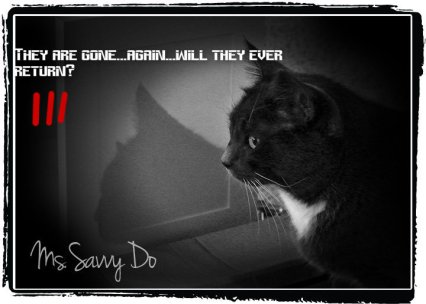
They have not even sent me a text message. How will they learn about my being denied my 10 times daily brushing?
It remains a mystery to me…how can Mom L just up and take off, leaving me alone with the human cat sitter and The Kid Sage? Who will get up 3 times every night and give me special pets and cuddles??
I am back again with Part Two in this series about the connections between cats, dogs, coyotes and wolves relative to finding a path to create greater safety for outdoor cats in particular, and small dogs as well. If you missed Part One, click HERE.
On our trip to Wolf Haven, September, 2014, one of only TWO ASA (American Sanctuary Association) accredited wolf sanctuaries in the USA , we were introduced to the connection between wolf recovery and the return to a balanced ecosystem. This included becoming aware of the direct link to gaining greater balance in coyote populations, which of course connected ME to sharing this information with my Paw Blog Community.
Someone once said to me that “cats are pretty low on the food chain”…they were referring to the dangers cats face from many predators in wildlife. And indeed this appears to me to be true. Upon further investigation and learning, the wolf was once the top predator across the USA, keeping the ecosystem in balance. We humans changed all that and continue to struggle with allowing the wolf to return to its natural role of maintaining the balance in our wildlife ecosystem.
The following video was created and produced specifically for Wolf Haven International. We were at its initial screening at the 2014 fund raiser Wine and Wolves.
Let me share some sites I encourage you to visit. There you can learn more about these three species of wolves in the USA. Anyone living in any of the directly affected states identified in these links can make a huge difference by supporting legislation to protect the wolves in that area from extirpation (Local extinction, or extirpation, is the condition of a species that ceases to exist in the chosen geographic area of study, though it still exists elsewhere. Local extinctions are contrasted with global extinctions).
Several readers commented on Part One about the lack of ever having had a wolf population in their states. Most of you who did so are located in the East and South East. I did a little research, and you may be intrigued, even astonished, to know. that once the Red Wolf populated far up the East coast, even into Canada.
Taken from the International Union for Conservation of Nature (IUCN) “As recently as 1979, the Red Wolf was believed to have a historical distribution limited to the south-eastern United States (Nowak 1979). However, Nowak (1995) later described the Red Wolf’s historic range as extending northward into central Pennsylvania and more recently has redefined the Red Wolf’s range as extending even further north into the north-eastern USA and extreme eastern Canada (Nowak 2002). Recent genetic evidence supports a similar but even greater extension of historic range into Algonquin Provincial Park in southern Ontario, Canada”
This wolf species is fascinating to view in real life. They have a very prehistoric appearance; similar to the Australian Dingo which is going through its own struggles with species survival.
You can see the similar head shape and other characteristics in these photos: the Red Wolf photo is taken from the United States Fish and Wildlife Services site (USFWS) and the Dingo photo is from Paw Nation.
The important note about this astounding discovery of a female Gray Wolf on the north rim of the Grand Canyon (see link below) brings to mind another learning from our visit to Wolf Haven.
There are currently ONLY 5 viable Mexican Wolf breeding pairs left in the wild. The genetic pool is dwindling. One speculation on nature’s way to preserve this species would be if the northern Gray Wolves wander further south, and the Mexican Wolves wander north…perhaps a mating between the two can bring an important gene contribution to keeping the Mexican species from extinction in the wild.
Whether this is a positive or a negative element that could lend itself to expansion of the breeding pool of Mexican Wolves remains controversial among those who are closely monitoring the survival plans for this species.
I hope with the discovery of this Gray Wolf on the north side of Grand Canyon means Mother Nature is at work in her mysterious ways!!
Now for those of you who have never heard even a pack of coyotes howling on the hunt at night, or just communicating with each other…have a listen to the wolves at Wolf Haven as the Animal Care Manager approached with some yummy meatball treats!
They know she is their best caretaker ever…(warning to all with cats and dogs close to you as you listen, they are sure to react to the harmony of the wolves)
Thank you for coming back for Part Two. Part Three will post on Wednesday, December 3 and it will have mostly photos!
Again, to read Part One clickHEREand to read Part Three clickHERE
Be Well, Mom L
From Savannah
It is unbelievable! Mom L did that ‘schedule ahead’ thing for my upcoming posts…and then she and Dad P practically flew out the front door!! Not even as much as a ‘by your leave’! If the human cat sitter shows up then I know I will be alone to fend for myself. She barely remembers to give me my kibble treats with my afternoon catnip tea.
All savanahspawtracks.com words and images from 2012 to eternity on this site may not be reproduced in whole or in part without written consent. Please contact me if you are interested in reprinting or using my images. My contact information is under my pull down menu ABOUT. Appreciate the cooperation. Paw Pats, Savannah











 Savannah's Paw Tracks