
Give Life to Free Roaming Cats #BtC4A
HIYA!! SAVANNAH HERE!!!
I am joining a movement which is near and dear to my heart. In case you are new to my blog, I am an adult shelter rescue cat…working hard to make a difference for all those similar to me—who do not have the voice I now have thanks to social media.

Are you ready to join me?
Today, I again proudly join the global Blog 4 The Change movement.

I pawticipate
My post this quarter is very important to any and all who want to see the live release rates RISE at their local public animal shelters. Come on, read more, learn, ponder the information and then hopefully, you will JOIN me and Mom L in helping all free roaming community cats live their lives beyond being trapped and left at an animal control shelter to be euthanized.
Interested? Read on.
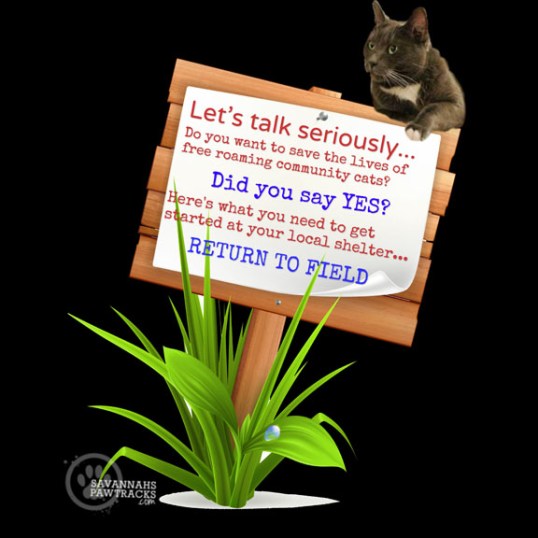
Now you may be wondering just what is the Return to Field Program? Mom L and I learned about this opportunity to save the lives of Free Roaming Community Cats (FRCC) through one of our rescue pals, Ms Julie, founder of Outcast Cat Help. Now you likely wanna know what is the difference between FRCC versus “Feral Cat”? Right??
Let me help you with that explanation. Basically, they are the same. End of explanation…ok? It is just a new label to address the same challenge.
THE CHALLENGE
FRCC/Feral Cats are frequently trapped by humans who feed them, but do not know what to do about managing the increase in numbers as the FRCC multiply due to lack of being spayed/neutered. Those cats are dropped at public animal shelters across the USA…and then the cats—who have been living a life free from humans, are subjected to anywhere from 72 hours to 5 days on “hold” just in case some human arrives to claim them. The ending is not freedom. It is almost always being euthanized. Healthy, but unadoptable, often young cats who have clearly been fed by someone who cared.
You can see that all these FRCCs are desperate, afraid and also…healthy, and longing to live.

Can I please leave now??
The FRCCs are both young and adult…

ENTER: RETURN TO FIELD PROGRAM
Advantages:
- FRCC receive FVRCP & rabies vaccintation; administered by the shelter, at no cost to the transfer partner rescue, for this program. Additionally, each cat receives an examination which includes a Body Condition Scale assessment (BCS) and is treated for fleas. Additional treatable medical issues are also addressed.
- The cats may be part of an established colony with a caregiver/feeder. The rationale behind RTF is that if the cat has a good or better BCS (not starving), that cat is getting food from somewhere.
- The FRCC must suffer through the hold period at public animal control shelters and all involved know that the end is death. When the public shelter has Transfer Partners in the local rescue community, these cats can be Returned to Field, meaning the area within which they were trapped, taking no longer than the time to recover from S/N surgery.
- Once the FRCC are removed from the shelter, there is SPACE for other cats who are not adverse to human contact; and who are adoptable. A Total WIN-WIN!
Concerns:
- Who will take care of the cats who are RTF’d? Great question. And, given that someone was kind enough to trap the cat, kittens etc….that means someone will care for the newly S/N cat/kittens and there will be NO MORE born into this community
- Kittens who are not open to socialization are returned with siblings and/or their Mom Cats
- Adults who are shy, but open to human contact are given the opportunity to live in foster and seek adoption.
Take a look at so many FRCCs being released through OCH’s transfer partnership with my county Animal Services Shelter…615 FREE ROAMING COMMUNITY CATS RETURNED TO FIELD…that is SIX HUNDRED FIFTEEN CATS SAVED!!
Which means MORE space at our county shelter for the adult cats and kittens who are truly adoptable…is there ever a better WIN-WIN???
Please support Return to Field in your local cat rescue community…just say’in…
PAW PATS, SAVANNAH
Additional Information:
Million Cat Challenge: Return to Field
Jackson Galaxy on Return to Field










 Savannah's Paw Tracks